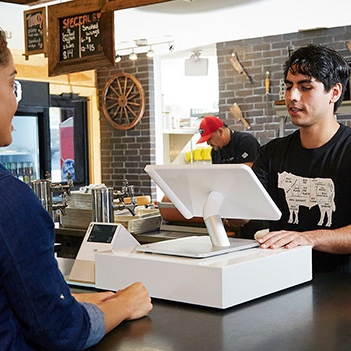
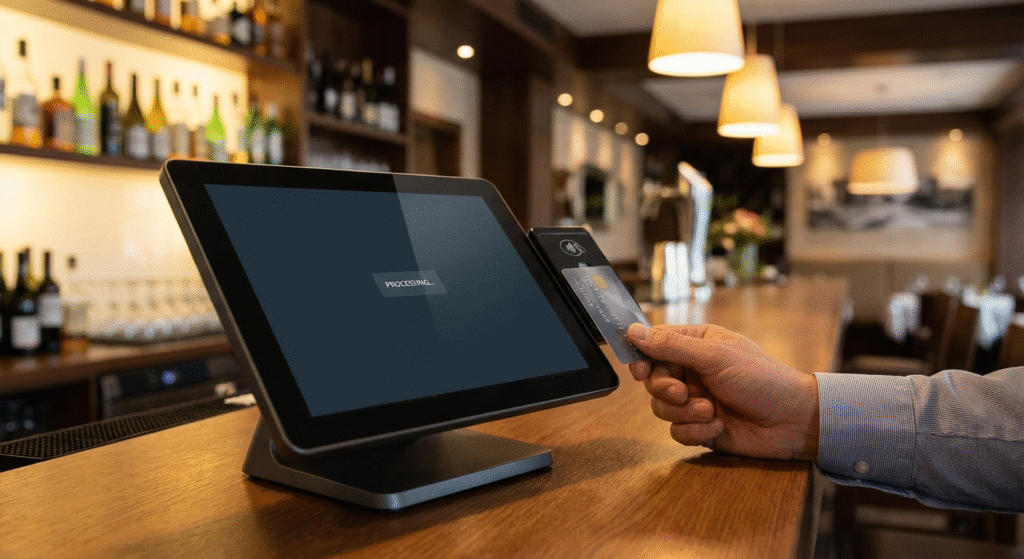
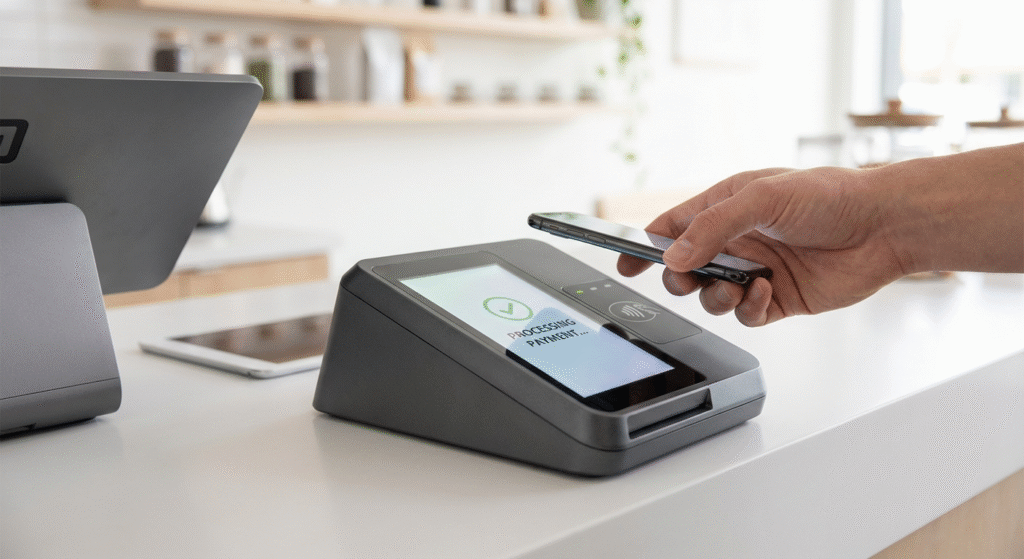
Choosing the right payment processor is one of the most critical decisions you'll make for your restaurant. The wrong choice can cost you thousands in unnecessary fees, create operational headaches, and frustrate both staff and customers. The right one? It becomes an invisible engine driving efficiency and profitability.

With so many restaurant payment processing options available, from traditional merchant services to modern all-in-one POS systems, how do you cut through the noise and make the right choice? This guide walks you through a proven decision framework used by successful restaurant owners nationwide.
Before diving into specific solutions, let's establish what makes restaurant payment processing different from retail or e-commerce.
The Unique Needs of Restaurant Merchant Services
Restaurants face unique transaction patterns that standard payment processors weren't designed to handle. You're dealing with:

- High tip volumes that need separate tracking for payroll
- Split checks and complex payment scenarios
- Table management integration requirements
- Kitchen display systems that sync with orders
- Multiple revenue streams (dine-in, takeout, delivery, online ordering)

The best POS for restaurants isn't just about accepting credit cards, it's about managing your entire operation seamlessly.
The Decision Framework: 5 Critical Factors
Transaction Volume and Fee Structure
Your monthly transaction volume determines which pricing model works best for you.
Low Volume (Under $5,000/month) For new restaurants or small cafes, flat-rate pricing like Square offers predictability. You'll pay around 2.6% + $0.10 per transaction with no monthly fees. The simplicity is worth the slightly higher per-transaction cost when you're just starting out.
Medium Volume ($5,000-$50,000/month) This is where restaurant payment processing gets interesting. You're large enough to negotiate, but small enough that you need to watch every penny. Consider:
- Interchange-plus pricing (typically 0.30% + $0.10 above wholesale rates) - Monthly fees between $50-$150 - Free or discounted hardware
High Volume (Over $50,000/month) At this level, merchant services for restaurants become highly negotiable. You should be getting:
Here's something most payment processor reviews don't emphasize enough: tip handling can make or break your staff's experience.

What to Look For:
- Automatic tip pooling and distribution
- Integration with your payroll system
- Tip adjustment capabilities (for those "I meant to tip $20, not $2" moments)
- Detailed tip reporting by employee and shift

Toast and Clover excel here, with built-in tip management that syncs with popular payroll platforms like Gusto and QuickBooks. Square's tip features are solid but more basic, fine for small operations, limiting for larger teams.
Online Ordering and Delivery Integration
The pandemic permanently changed how restaurants operate. If you're not set up for online ordering and delivery integrations, you're leaving money on the table.

The Integration Question
Ask potential providers: "How does your system handle DoorDash, Uber Eats, and Grubhub orders?"

The best restaurant POS systems pull third-party delivery orders directly into your kitchen display system, eliminating tablet clutter and manual entry errors. Toast's integration suite is particularly robust, with direct connections to major delivery platforms.

Your Own Online Ordering
Even better? A POS that includes white-label online ordering so you can avoid those brutal third-party commission fees (typically 15-30% per order). Toast and Square both offer this, though Toast's implementation is more restaurant-specific.
Hardware Reliability and Support
Payment processing hardware takes a beating in restaurant environments, spills, heat, constant use, and occasional rage-induced impacts (we've all seen it happen).

Durability Considerations:
- IP-rated water and dust resistance
- Commercial-grade components
- Easy-to-clean surfaces
- Battery life for tableside ordering

Support When Things Break
More important than the hardware itself: what happens when it fails during Saturday dinner rush? Look for:

- 24/7 phone support (not just email)
- Advanced hardware replacement (shipped before you return the broken unit)
- Local service technicians for enterprise installations
Contract Terms and Flexibility
This is where restaurant owners most often get burned.

Red Flags to Avoid:
- Long-term contracts (more than 1 year)
- Early termination fees over $500
- Equipment leasing (almost always a bad deal)
- Automatic rate increases without notification

Green Flags to Seek:
- Month-to-month agreements
- Equipment purchase or transparent rental options
- Price lock guarantees
- Easy export of your data if you leave
Comparing the Top Restaurant POS Options
Toast POS: The Restaurant-Specific Powerhouse
Best For: Medium to large restaurants prioritizing integration depth

Toast was built specifically for restaurants, and it shows. Their system handles everything from reservation management to inventory tracking, with particularly strong online ordering capabilities.

Pricing: Custom quotes based on volume, typically 2.49% + $0.15 for in-person transactions. Higher monthly software fees ($165+ per terminal) than competitors.

Strengths:
- Deep restaurant-specific features
- Excellent delivery integration
- Comprehensive reporting
- Built-in loyalty programs

Limitations:
- Higher cost than alternatives
- Can be overkill for very small operations
- Proprietary hardware lock-in
Square for Restaurants: The Accessible All-Rounder
Best For: Small to medium restaurants wanting simplicity and flexibility
Square brought transparent pricing to merchant services for restaurants, and their restaurant-specific version adds crucial features like course firing and table management.
Pricing: Flat 2.6% + $0.10, no monthly fees for basic features. Premium features ($60/month per location) add advanced inventory and employee management.
Limitations: - Less sophisticated than Toast for complex operations - Limited customization options - Support can be slow during peak times
Clover: The Customizable Middle Ground
Best For: Restaurants wanting flexibility and customization

Clover offers a modular approach, buy only the features you need. Their app marketplace lets you add capabilities as you grow.

Pricing: Variable depending on processor and plan, typically 2.3% + $0.10. Hardware and software fees vary widely.

Strengths:
- Highly customizable
- Strong third-party app ecosystem
- Multiple hardware options
- Good for diverse business types

Limitations:
- Complexity can overwhelm new users
- Quality varies by processor partner
- Pricing less transparent than Square
Making Your Decision: A Step-by-Step Process
Step 1: Calculate Your True Processing Costs
Don't just look at the percentage rate. Calculate total monthly cost including:
- All transaction fees
- Monthly minimums or software fees
- Hardware costs (purchase or rental)
- Add-on features you'll actually use
Step 2: Test the Systems Hands-On
Most providers offer free trials or demos. Actually run transactions. Add menu items. Process a split check. If the demo feels clunky, the reality will be worse.
Step 3: Talk to Current Restaurant Owners
The best research happens over a beer with another restaurant owner. Ask:
- "What surprised you after signing up?"
- "How's their support when things break?"
- "Any hidden fees you didn't expect?"
Step 4: Negotiate Based on Volume
Everything is negotiable in restaurant payment processing. Use competing quotes as leverage. If you're doing over $20,000/month in transactions, you should be getting custom rates. This is where Lucrative Merchants can help you.
Step 5: Plan Your Transition
Switching payment processors is disruptive. Plan the change during your slowest period, train staff thoroughly, and keep your old system accessible for a few days as backup.
The Independent Advisor Advantage
Here's the uncomfortable truth: most "reviews" of merchant services for restaurants come from affiliate marketers earning commissions on signups, or from the processors themselves.

At Lucrative Merchants, we work differently. We're independent advisors who analyze your specific situation, transaction volume, business model, operational needs, and recommend the best fit regardless of which provider it is. We're not tied to any single processor, so our advice is genuinely in your best interest.

We've helped hundreds of restaurants save an average of $6,200 annually on processing fees while improving their operational efficiency. Sometimes that means Toast. Sometimes it's Square. A lot of merchants like Clover. Often it's a regional processor you've never heard of that happens to be perfect for your situation.
Key Takeaways
Match pricing to your volume: Flat-rate for low volume, interchange-plus for high volume
Prioritize tip management: Your staff will thank you, and it reduces payroll headaches
Demand delivery integration: Tablet hell is avoidable with the right system
Avoid long contracts: The restaurant business changes too quickly for multi-year commitments
Calculate total cost: The advertised rate is just one piece of your actual expense
Test before committing: A free trial reveals more than any sales pitch
Ready to Find Your Perfect Payment Processing Solution?
Choosing the best POS for restaurants doesn't have to be overwhelming. Our team at Lucrative Merchants specializes in cutting through the marketing noise and finding the solution that fits your specific needs and budget.
Get a free, no-obligation consultation where we'll analyze your current processing costs, understand your operational needs, and recommend the optimal solution, whether that's one of the big names or a specialized provider you haven't discovered yet.
No sales pressure. No commissions from processors. Just honest advice from people who understand restaurant operations.
In today’s fast-paced digital economy, efficient merchant services and secure payment processing are the backbone of every successful business. Whether you’re running a brick-and-mortar store,